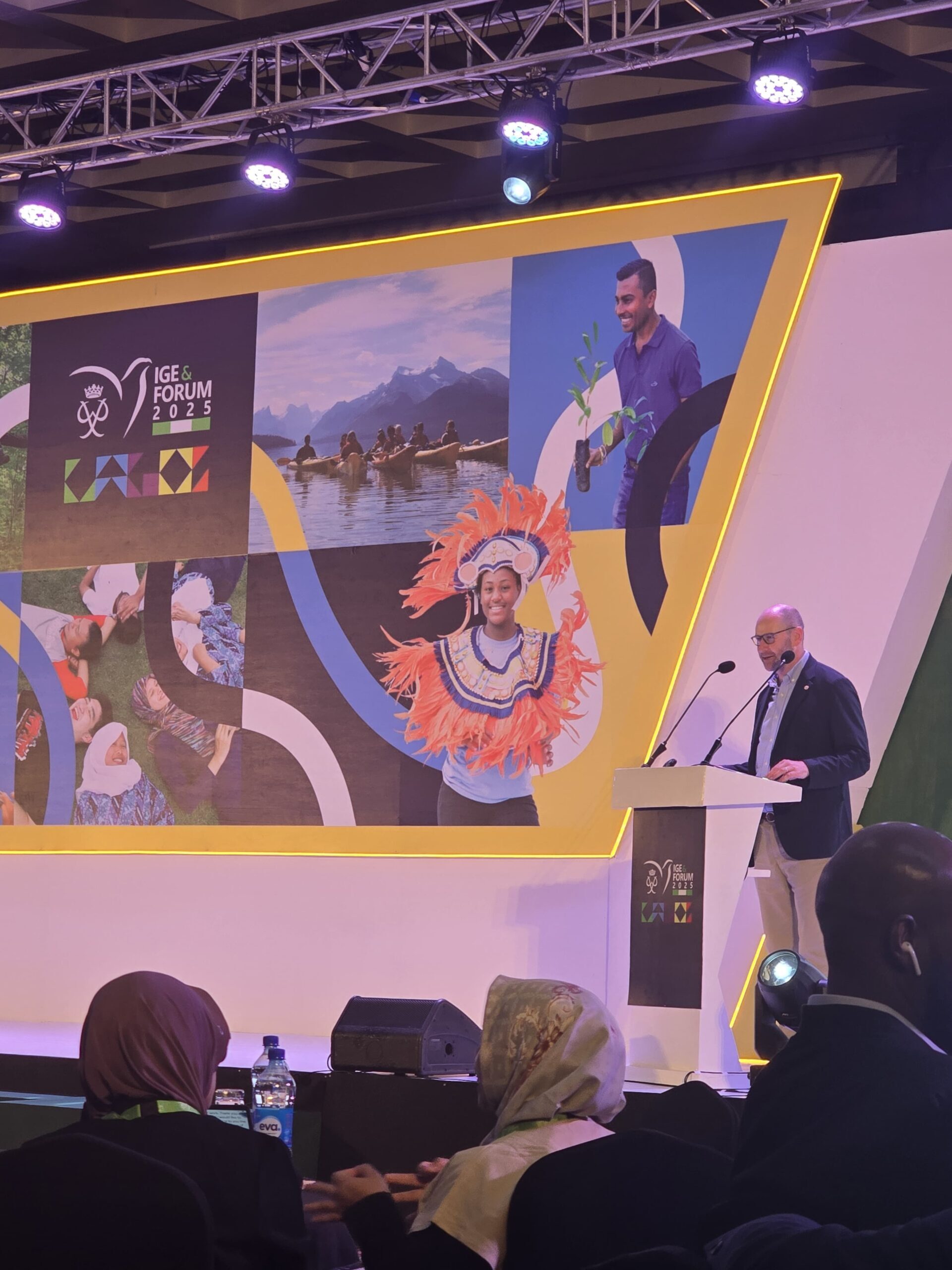
Keynote speech by Martin Houghton-Brown, Secretary General of The Duke of Edinburgh’s International Award Foundation
Let me start with a question — one that will guide everything I want to say this morning:
What have we as the Award to offer the young people of this generation, a generation that is increasingly being pulled apart,— and crucially how do we, as the Award family, help shape that story?
Hold that thought. We’ll come back to it.
This past year, something has shifted across our global community. We are beginning to see the first fruits of our Association Strategy.
We can see it in the numbers – with 1.2 million participating this year, a year on year growth of 4%, and importantly an improved 6% growth on Awards achieved and we are successfully operating in over 120 countries. We have beaten the Covid slump and we are back on course, congratulations to all of you who have made that your mission these past three years.
We are doing this country by country, initiative by intitiative, finding new ways to demonstrate why the Award framework is as fresh today as it was 69 years ago.
In Canada, the “Award Canada Way” is re-engineering how the Award works in schools. Until recently, most participants came from just twenty-three independent schools. Now, through partnerships with public boards, trades colleges, and virtual hubs, the potential reach has grown to half a million young people. Half a million! All because our colleagues dared to ask: “What if experiential learning could sit inside the school timetable, not outside it?”
We are seeing a commitment to promoting the role of young people in civic life, as Awardees wear their Award participation with Pride. In the Bahamas, , where by the way they might just have the coolest clothing merchandise, well I love my polo anyway, participants have organised youth marches, mangrove planting, and coastal clean-ups, building community pride and environmental stewardship. With training and coordination, their achievements have become visible on a national scale.
And then here in Nigeria, something extraordinary is happening. Their Bronze First Project is turning what looked like an obstacle — the National Youth Service Corps travel restrictions — into innovation.
Picture this: a group of NYSC members, scattered across 774 local government areas, completing their Adventurous Journey by route-planning in teams online, walking in their local communities, recording reflections on the Online Record Book, cheering each other on through a shared platform.
It’s not just a technical fix; it’s a breakthrough in access and safety. The Award reaching tens of thousands of young Nigerians — educated, service-minded, ready to build their country. And how wonderful it was to be able to celebrate this with the President of Nigeria himself when His Royal Highness visited His Excellency in Lagos earlier this week.
That’s what innovation looks like when it is grounded in purpose.
Now, the world around us is changing faster than any generation has ever known.
We are in a world where young people are being increasingly isolated. Isolated from reality by their virtual worlds, hidden behind their screens. Hidden from power as their voices are not listened to. And isolated from opportunity even as AI begins to change education and threatens jobs.
In a world where algorithms can mark essays, translate languages, even generate art. But cannot teach compassion, courage, or curiosity.
We are here able to teach what it means to serve.
We are committed to opening doors for those who face the greatest barriers to opportunity. In Nepal, a pilot project brought the Award to child labourers—young people who often have little time or support for their own development. Through the Award, they gained not just confidence and literacy, but also a sense of belonging and hope for the future.
The Award is a counter-culture to the instant and the superficial. It asks for perseverance, teamwork, and reflection — the very muscles that make citizenship possible.
Sometimes, the most profound change begins with the initiative of a single young person. In Mozambique, a student who moved from the vibrant and growing Award in Zambia inspired their new school to launch the Award, resulting in the country’s very first Award Centre—a powerful example of youth leadership sparking national growth.
We provide what a recent Harvard Business Review article described as Foundational skills— collaboration, problem solving, and adaptability.
In the UK recently the DofE Award team have begun to build an alliance of organisations focussing on what it means to enrich the communities in which young people live, breaking out from their online spaces. The UK Government have even set about to create Enrichment Benchmarks.
And so, as technology accelerates, our mission doesn’t shrink; it expands. We are not competing with screens; we are completing what screens cannot achieve.
Learning from others — IFRC and the art of scaling
We are challenged therefore by this rapidly changing environment and of course by our strategy, to understand how we grow and what we do next.
And to be clear it is one thing; to scale up sustainably, with sufficient momentum that is effectively funded, to make it possible for at least 1% of the young people, in your nation, to have access to the Award and where you have achieved that to push your goals, to 5% and even to 25 and 50% – we are seeing how that can be done in nations small and large.
But, scaling isn’t about one country leading the way, or a single model being copied everywhere. It’s about teamwork—a global network of colleagues, each bringing their strengths, sharing what works, and learning from each other.
Think of the International Red Cross and Red Crescent Movement. Their work this year has reached so many of our countries, from responding to earthquakes in Nepal to bushfires in Australia, from conflict zones to the most recent hurricane in Jamaica. Its reach spans nearly every country, not because of a central authority dictating every action, but because national societies work side by side, sharing expertise, resources, and support. When disaster strikes in one part of the world, teams from across the globe mobilise, bringing their experience and solidarity to help communities rebuild.
When we act as a global team, every community—wherever it is—can benefit from our shared endeavour.
Growth doesn’t mean more control. It means more confidence in each other. And I do have confidence in you. I will champion your capacity and your solutions. As Secretary General, I stand for you, with you, and to champion your role in the world of non-formal education and learning. And I know there is much that you expect of me and rightly so.
Empowering Operators and each other
But I am not your only champion. Every time an NAO takes on Forum, they take on the challenge of championing the entire Association. So taking on Forum is a massive task and I am deeply grateful for all that Joseph and the team in Nigeria have prepared for us here at Forum, and deeply respectful of the Foundation teams who have worked with them to deliver this event. We have trusted our NAO in Nigeria with Forum and WOW what an impact that trust has had.
Trust is at the heart of every story of growth. When a young person joins the Award, they step into a promise: that those guiding them will protect, encourage, and listen. That is the context for their personal growth.
And we have been doing exactly that this year – building protections into our culture and standards, ensuring safety remains at the core. Thank you to everyone who has championed this over the past year. Because of our collective effort, we can now celebrate a global standard of safeguarding.
Now, our focus must shift to the next phase of construction: building our global association, our community of operators who are financially self-sustaining and whose stories of Award impact inspire young people, parents, educators, and policymakers to sign up.
I am grateful that most of you took the time to look at your financial sustainability and impact in the pre Forum survey, and you helped us to see where we need to focus:
You told us that 78% of your organisations need to reinforce your financial foundations, 39% need to strengthen leadership capacity, 52% need help with strategic planning, and 66% have work to do on your business plans. Many of you have already identified where you need support. Let’s be honest about where we can offer help and where we need to ask for it.
The Foundation cannot—and should not—build this alone. We must construct it together, as an Association of Operators.
This must be a shared resource model.
Across the world where Operators help Operators, we create a culture of shared strength. Imagine an Association where directors in developing NAOs work alongside mentors from those more established ones—sharing blueprints, materials, and skilled hands to strengthen every part of our community.
Imagine ‘construction teams’ where National Award Organisations tackle shared challenges, from insurance to inclusion, and co-design solutions, each team contributing to the architecture of our global organisation. And imagine building tools that allow every Award Centre, no matter how small, to see itself as part of a global system—connected, accountable, and celebrated.
That’s how we will grow: centre by centre, brick by brick, not just country by country
We must therefore now recalibrate the way the Foundation works. Our role is not to construct every wall or lay every brick ourselves, but to ensure that each of you has what you need to build with confidence and skill. That means changing how we operate—enabling you to help each other, and directing our resources, including the vital grant funds we steward, to where they will have the greatest impact.
I remember once taking over a large building in central London with a vision to use it for young people at risk on the streets. It was a mess, and every person I took around it said to me, “Martin it’s a mess, it will be impossible to make it fit for purpose”. Now I had a vision, and I was determined. You will learn this about me, I am relentless when I have a vision. Anyway we agreed the plans, we raised the money, and then the work began. But this is where I needed help, because at every stage we needed someone to check that the builders were on track, they had all that they needed and that they would finish on time and to budget, and so we hired Tom and he was brilliant. He would report to me on progress, offer challenge and support to the whole project team, and crucially he ensured the various contractors were helping each other to achieve the same goal. And so we finished, on time and to budget. And to this very day Depaul UK in London is helping children find a safe place for the night.
We at the Foundation need to change. Think of us less as the constructors and more as the people like Tom: not doing the construction, but working alongside you to ensure that the design we have agreed together is realised, and that every resource is used as efficiently and effectively as possible.
This is how we will build a structure that is not only strong, but truly fit for purpose—crafted together, with each operator’s strengths and context at its heart. With transformative change for the Foundation too.
As we recalibrate the way the Foundation works—moving from compliance officers to development partners —I invite each of you to pause and reflect too.
Where do you see yourself in this work? Are you bringing new ideas, offering your experience, or helping others in the Association to grow? Perhaps you’re leading the way, or perhaps you’re preparing for deeper growth yourself. What can you offer, and where do you need support?
Before we move forward, let’s not lose sight of why we are building at all. Every blueprint we draw, every foundation we lay, every wall we raise together—these are not ends in themselves. They are the means by which we create the conditions for young people to thrive. The Award is not just about structures or systems; it is about shaping the character and resilience of the next generation, for young people like Veronika.
From good to great
You see our mission is to ensure that no young person is left behind, even in the most challenging circumstances.
I was recently with some World Fellows listening to a remarkable young woman called Veronika,
She described waking up to bombs dropping in her home city of Kyiv. She fled the war in Ukraine and found herself in Italy, grieving and adrift.
But Rachel who leads the IAC Rachels Learning Centre welcomed Veronika into the Centre, there Veronika rebuilt her sense of purpose and community through the Award.
Extraordinarily Veronika speaks about how her voluntary service helping other refugees is her happy place. When Veronika shared her story with the World Fellows last month there wasn’t a dry eye in the house.
Her journey is a reminder that our work reaches young people even in the most difficult circumstances, helping them find hope and belonging.
That is the kind of citizen we are shaping. As Maya Angelou said: ‘People will forget what you did, people will forget what you said, but people will never forget how you made them feel’
I’m sure all of us across the Association have our own stories of people like Veronika, which show us how we are collectively helping to develop compassionate, service minded and resilient citizens.
Reach for the Sky — our shared horizon
When His Royal Highness shared the Association Strategy, Reach for the Sky we could see that at its heart was exactly that vision, one of young people who are truly World Ready– and we all thought this is ambitious and exciting.
But if I may Your Royal Highness – you are the architect and the architect doesn’t build the building, they need us, the construction workers, and project managers to build out the vision.
Kurt Hahn wrote that education’s foremost task is to ensure “an enterprising curiosity, an undefeatable spirit, and above all, compassion.” Those qualities aren’t just for young people; they’re for us too.
As we embrace the challenge ahead of us, I want us to be curious about what we need to learn, what could we do differently.
Nelson Mandela once said: ‘I never lose. I either win or learn’. And it is this spirit of trying new things, and learning from both our successes and our failures, which I want us to collectively embrace across the Association.
The Bronze First pilots should be contagious, learn from one another, and begin your own initiative, think what would it take to bring thousands more young people on the first step of their Award journey?
And then we need to be courageous – undefeatable as we face up to the challenges that we choose. If we don’t change what we are doing, we will get what we have always had, and will never break that glass ceiling of a global 1% participation in the Award.
Creating change can be unsettling and so I am pleased that Hahn asks us to remember that above all we need to be a people of compassion.
And that is the kind of citizens we want to build – it is the question I asked when we started, What kind of people will our young citizens become?
Here’s my answer now: They will become what we model. Curious, Undefeatable, Compassionate.
Will you be curious? Seeking a new way to build your oganisation and find new methods to reach even more young people? Will you be undefeatable? As Ghandi said, there defeat is not in my dictionary, facing the challenges that will come as you grow and find the resources you need to grow sustainably. Will you be compassionate? Treating your colleagues wherever they work or volunteer with kindness and respect
If we model these Hahnian characteristics, if we give ourselves fully to this task then we will build an Award that will serve generations of curious, undefeatable and compassionate young people in the decades to come.
Thank You.