Human skills are the capabilities that help people navigate change, work with others and act with purpose. In a world shaped by rapid technological change, they are increasingly recognised as essential to learning, work and contribution throughout our lives.
What we mean by Human Skills
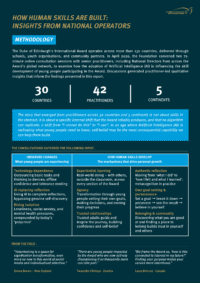
Human Skills are the foundational capabilities that shape how people learn, lead and contribute. In this framing, they are not “soft” or optional add-ons. They are the ability to take initiative, persist through challenge, work well with others, make sound judgements and contribute to something bigger than yourself. We think of them through three connected ideas: agency, capability and contribution.
- Agency – the confidence and willingness to act, take responsibility and keep going when things are difficult.
- Capability – the ability to develop and apply skills, make judgements and influence outcomes effectively.
- Contribution – a sense of purpose, belonging and responsibility to others, communities and society.
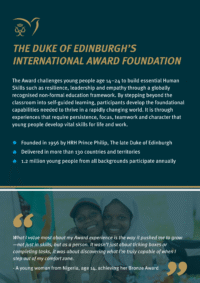
We know that these skills are consistently fostered by young people using The Duke of Edinburgh’s International Award framework.
Why Human Skills matter
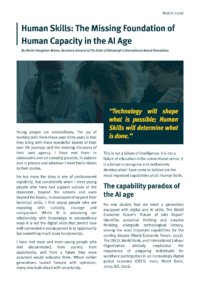
Judgment, purpose, and responsibility are the true drivers of human capability. Digital and technical skills are important, but they are most powerful when built on a strong foundation. Digital tools amplify what already exists beneath them: when young people have confidence, resilience, and a sense of purpose, technology can help them create, lead and solve problems; when those foundations are weak, technology can just as easily amplify passivity, confusion and poor judgement. They also matter because they are linked to better long-term outcomes.
Who is backing Human Skills globally
A growing group of global institutions is reinforcing the case for Human Skills.
- The World Economic Forum continues to identify skills such as resilience, leadership and social influence as central to future employability.
- The OECD has highlighted the importance of social and emotional skills, as well as the wider mix of skills and attitudes needed for resilient societies.
- The World Bank has described social and emotional skills as a new currency for navigating a fast-changing world, especially for young people.
- The International Labour Organization has also stressed the need for adaptable workforces and resilient skills systems as labour markets evolve.
This matters because, although the language varies from one institution to another, the direction is remarkably similar. Whether they are called Human Skills, social and emotional skills, durable skills or power skills, the message is clear: these capabilities are fundamental to how people adapt, collaborate, lead and thrive in changing economies and societies.
What The Duke of Edinburgh’s International Award is doing
The Duke of Edinburgh’s International Award provides a framework used by 1.2 million young people annually to build Human Skills in more than 130 countries each year. But our ambition is greater. We want every young person to be able to build these skills. For our own part, we are working to ensure 4 million young people use the framework each year by 2031.
The Foundation is also working to strengthen the wider case for Human Skills globally. This includes building a stronger shared narrative, connecting practitioners, policymakers and investors, and making the Award more relevant to decision-makers’ priorities. Our ultimate goal is to ensure Human Skills are viewed as foundational to education, employability and youth development.
To accelerate this, we are championing a more deliberate conversation about how these skills are developed, recognised and invested in. We will be working to ensure stronger global alignment through the development of a Global Human Skills Forum and a Global Human Skills Observatory. We are working with our partners in multilateral organisations, national governments, academia and youth development worldwide to create a shared space for evidence, practice and policy to come together.
To find out more about how you can play your part, contact:
Robbie de Santos, Director of External Affairs and Communications
Mariana Roa, Global Advocacy Manager